Administrative Operators
Keep processes, schedules, records, documents, and internal operations moving.
See the SWOT promptPractical thinking for AI-era work
AI is changing tasks, roles, expectations, and business models. To respond well, you need a clearer picture of your own work—not just another prediction about jobs.

The problem
When a task becomes faster, cheaper, or self-service, an organisation may rethink the workflow around it: who does the work, how many people are needed, and what skills matter. A job title alone rarely tells the whole story.
The useful question is more specific: which parts of your work are changing, what value do you still bring, and what could you do next? ADAPTOR gives those questions an order.
The free framework
ADAPTOR is a complete, free method for turning uncertainty about AI and work into a plan you can revisit. Its seven Work Profiles help you see what your role is made of. From there, you build a Personal SWOT, choose goals, and take action.
Step 1 · Profile
Each letter in ADAPTOR names a Work Profile. Most roles are a mix: choose a Primary Profile for the work people mainly rely on you to do, and a Secondary Profile for another important part. The profiles are lenses for your Personal SWOT—not personality types or a verdict on job risk.
Keep processes, schedules, records, documents, and internal operations moving.
See the SWOT promptCreate, configure, code, automate, design, maintain, or implement digital systems and outputs.
See the SWOT promptResearch, interpret information, compare options, analyse data, and support decisions.
See the SWOT promptProvide expertise, judgement, compliance support, consulting, coaching, or specialist services.
See the SWOT promptCoordinate people, projects, delivery, stakeholders, decisions, and execution.
See the SWOT promptProduce written, visual, strategic, educational, communication, or creative outputs.
See the SWOT promptCreate value through direct human interaction with customers, clients, users, patients, or communities.
See the SWOT promptStep 1 → Step 2
For example, an administrative coordinator might combine Administrative Operator with Team Coordinator. That points them towards routine meeting summaries and sensitive follow-up. They can then ask what they have actually observed: is handling exceptions a Strength? Is self-service summarising a possible Threat? The profile identifies the work to examine; the SWOT assesses their own position.
Follow the complete four-step guidePut the method to work
Once you understand the sequence, start small. The ADAPTOR Starter Exercise helps you take one recurring activity through Profile, Personal SWOT, Goals, and Action. It gives you a first useful result you can extend across the rest of your role.
No account or email is needed. The framework and its full guide remain free to use.
Open the Starter Exercise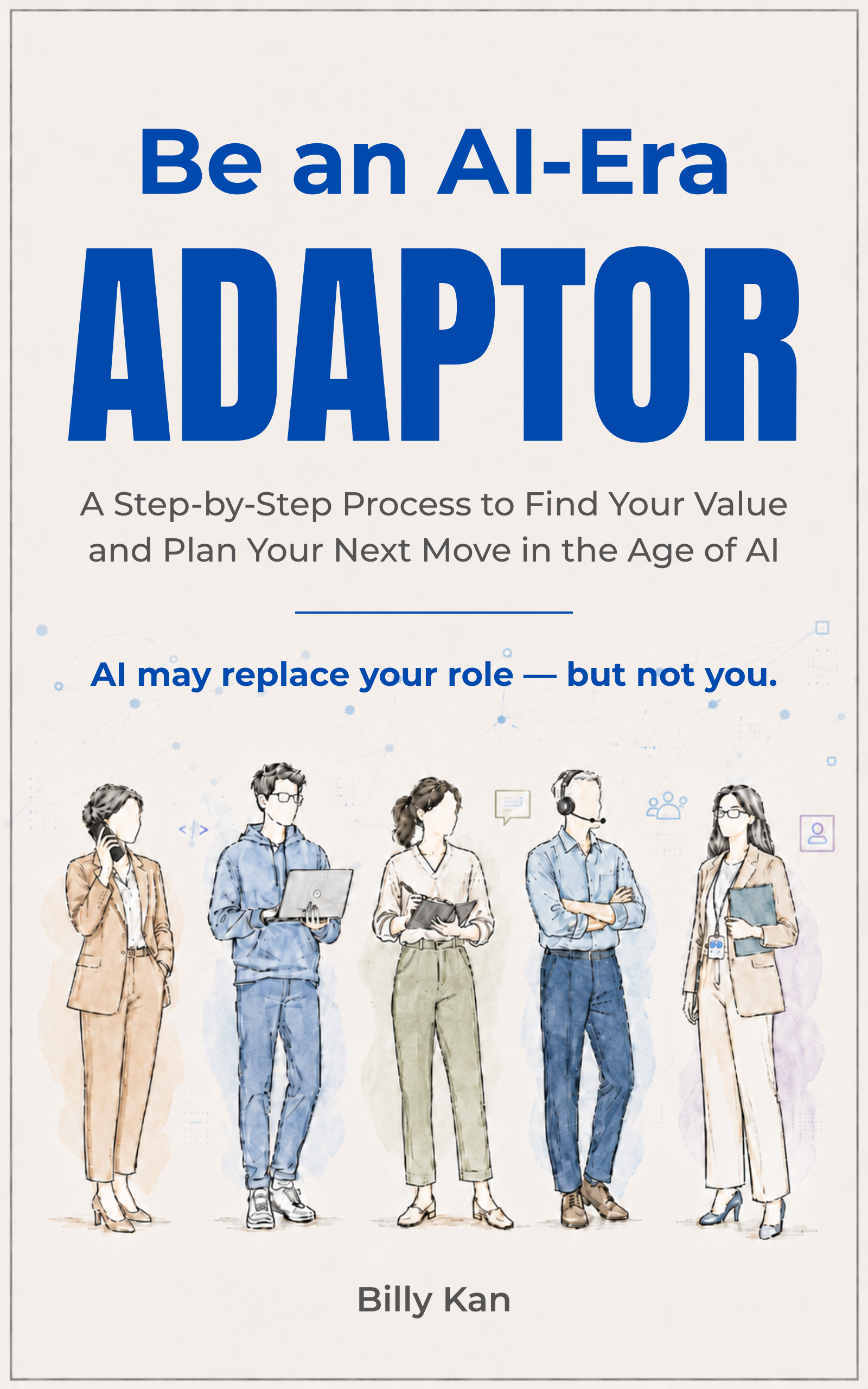
Go further with the book
The framework is yours to use without buying anything. Be an AI-Era ADAPTOR makes it easier to put the method to work through deeper guidance, worked examples, a structured assessment, and a companion workbook for purchasers.
If your first exercise raises more questions about your role or next move, the book helps you work through them in more depth.
See what the book addsFurther reading
Worried about AI and your job? Map one weekly task, check what is changing, and decide what to watch next.
Worried AI could replace your job? Examine demand for your work, separate evidence from assumptions, and choose a practical next step.